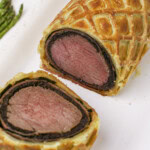
Beef Wellington
Beef Wellington is known to be a luxurious English dish made only for special occasions, like the holidays! It's made of with a log of tender center-cut beef tenderloin wrapped in layers of duxelles, prosciutto, spinach, and flakey puff pastry. It's a dish perfect for impressing and pairs perfectly with some sautéed broccolini and creamy mashed potatoes!
Ingredients
For the beef:
- 3 pounds beef tenderloin center cut trimmed and silverskin removed
- 2 tablespoons dijon mustard or yellow mustard
- 1 tablespoon Kosher salt or as needed for seasoning
- 1 tablespoon oil
For the duxelles:
- 48 ounces baby portobello mushrooms
- 7 ounces shallot finely chopped (about 3 large shallots per 7oz)
- 1 teaspoon fresh thyme leaves
- ½ teaspoon Kosher salt
- ¼ teaspoon cracked black pepper
- 4 tablespoons unsalted butter
For the puff pastry:
- 1 box puff pastry sheets defrosted (17.3oz/490g per box)
- 2 large egg yolk
- 1 tablespoon milk or water
Other ingredients:
- 2 bunches spinach stems cut and discard *see notes
- 6 ounces sliced prosciutto or parma ham
Instructions
For the beef tenderloin:
- Season the beef tenderloin generously with kosher salt. Then wrap the beef with cling wrap and roll it into a tight cylinder. Refrigerate for at least 1 hour but best overnight.
- After resting, unwrap the beef. Heat a large pan over medium high heat and add the oil. Once the oil is hot, sear the beef on all sides, including the ends, until a light golden color. It doesn't have to be be a hard sear. This is just to help seal in the juices not to cook the tenderloin.
- Brush the beef tenderloin with mustard all around. Then refrigerate the beef refrigerated until cooled or until needed while you prep the other ingredients.
For the duxelles:
- Clean the mushrooms and trim the stems if needed. Finely chop the mushrooms either by hand or use a food processor. If using a food processor, you may need to do it in sessions and scrape down the wall of the processor occasionally.
- In a large pan medium high heat, add the butter. Once the butter is melted, add the mushroom, shallot, thyme leaves, salt, and pepper. Cook the duxelles until it's fairly dry and crumbly, about 20 minutes. Make sure to stir often, especially when the duxelles becomes dry. You may also need to reduce the heat as more moisture is cooked out of the mushrooms.
- Once the duxelles is dry and crumbly, remove and set aside to cool. You can make the duxelles up to 2 days ahead of time.
For the spinach (optional step/layer):
- Bring a pot of water to a boil and prepare a bowl of ice water. Add the spinach to the boiling water and cook until wilted. Drain the spinach and immediately place it into the bowl of ice water. Cool the spinach completely then drain well. Gently squeeze the spinach to remove excess moisture. Set aside until needed.
Assembly:
- Lay down a couple layers of cling wrap on your work surface. For the first layer, gently spread open each spinach leaf and lay them down to make a rectangle about 2 inches longer than your beef tenderloin and about 2.5 times the width of the tenderloin. You want to be able to completely wrap the tenderloin in it. Make sure to overlap the spinach and if you have enough, double up on the layer.
- Next is the parma ham/prosciutto layer. Peel off a slice of prosciutto but keep it on the paper separator. Place the prosciutto on the spinach layer then gently peel off the paper. Repeat this process until the entire spinach layer is lined. You'll want to overlap each slice of prosciutto but by no more than 1 inch. If there are any holes, patch it up as needed at the end.
- The final layer is the duxelles. Simply spread the cooled duxelles evenly over the prosciutto. Then press down firmly to compress the duxelles into a solid layer and to help it stick to the prosciutto layer.
- After all the layers are assembled, place the cooled beef tenderloin at the center of the duxelles. Using the cling wrap, lift the 3 layers over the tenderloin. Peel back the cling wrap as needed as you roll the tenderloin to the other end. It's ideal for the layers to overlap slightly so the juices stay sealed in after baking. Fold the ends in to seal the sides. Then wrap the log securely with the cling wrap. Twist together the cling wrap at the ends of the log and roll the log while holding the cling wrap to create tension and keeping the log tight and round. Place the log in the fridge as you prepare the puff pastry.
Puff pastry assembly:
- Preheat the oven to 420°F/215°C and make an egg wash for the puff pastry by beating together the egg yolks with milk. Set aside until needed.
- Take out only one sheet of defrosted puff pastry and keep the other refrigerated. On a lightly floured surface, roll out the puff pastry so that the length is about 3 inches longer than your beef log and the width is wide enough to wrap around the beef log and overlap by about 1 inch, so about 3 times the width of the log.
- Take the beef log out from the fridge and remove the cling wrap. Place the log in the middle, at one end of the puff pastry. Brush the other end, about a quarter of the way, with egg wash. Roll the log with the puff pastry to the other side. Make sure the puff pastry overlaps. Fold the puff pastry on both ends down and tuck it underneath the log. Place the log onto a parchment lined sheet pan and keep refrigerated while you work on the other sheet of puff pastry.If you don't want to add the lattice work, you can go ahead and brush the outside of the puff pastry with egg wash and bake. You can also add some decoration with the scrape or with the other sheet of puff pastry.
- If adding lattice work:Now onto the lattice work. On a cutting board or the back of a cold sheet pan, light dust it with flour. Roll out the long side of the puff pastry until it is about 2 inches longer than the log. Check and make sure the bottom of the puff pastry doesn't need more dusting, then use the lattice cutter and cut the puff pastry long ways. Make sure to cut with firm, even pressure all the way and you want the lattice lines to run parallel to the long side of the puff pastry. After cutting, go back and make sure all the cuts are cut all the way through. If not, use a paring knife to finish the cuts.*If the puff pastry becomes a bit warm during this process, place it in the fridge for 5-15 minutes.*
- Take the log out of the fridge and brush the entire surface with egg wash. Then drape the lattice puff pastry over the log. You can do so by holding the cutting board or sheet pan over the log and shake the pan with a shimmy motion to move the puff pastry. This way, you won't overstretch the pastry dough. Make sure the lattice cut is parallel to the length of the log. Once the puff pastry is draped over the log, adjust the dough so the lattice pattern is presented nicely. Cut off the excess dough and tuck the ends under the log. Brush the lattice with egg wash.
Bake:
- Place the Beef Wellington into the oven and bake for about 40 minutes for rare, 45 minutes for medium rare, and 50 minutes for medium tenderloin. After 20-25 minutes of baking, or when the puff pastry is nicely golden brown on the outside, loosely place a sheet of foil over it to prevent the puff pastry from becoming too dark.*Every oven is different, so adjust your cooking time as needed. The oven temperature for this recipe is for conventional ovens. For convection ovens, lower your oven by 25°F. The best way to check your Beef Wellington's doneness is with a kitchen thermometer. You can either have a cooking alarm thermometer inserted or test the internal temperature with a thermometer closer to time. For rare, remove the Wellington at 105-108°F (40-42°C), medium rare at 110-115°F (43-46°C), and medium at 115-120°F (46°F-49°F). The carryover heat will cook the beef Wellington to the perfect doneness.
- Once done baking, remove the Beef Wellington and let it rest at room temperature for about 25-30 minutes. This resting time is important to let the tenderloin and the duxelles absorb all the juices and to bring the tenderloin to your desired doneness. If cutting early, the Wellington may be undercooked.
- After resting, portion and cut the Beef Wellington with a serrated knife. Enjoy while hot!
Notes
Please refer to the post above for step by step photo reference, tips, and FAQs!
- Center-cut tenderloin - This is the middle, most even section of a beef tenderloin. You can request it from your butcher or purcahse a whole tenderloin and cut it yourself. The end pieces can be saved for other recipes.
- Spinach layer - this layer is optional and can be omitted but it adds a nice green layer. The spinach we recommend using are spinach by the bunch or even Taiwanese spinach because they're larger in size and less fragile than baby spinach. If using larger spinach varieties, cut and discard the stems. The stems are too stiff to roll up properly in the wellington.
- Puff pastry sheets - Make sure you use SHEETS and keep the puff pastry chilled. If the puff pastry gets too warm, you can always pause and refrigerate for 5-15 minutes.
Nutrition
Serving: 1slice | Calories: 669.4kcal | Carbohydrates: 57.4g | Protein: 17.2g | Fat: 44.2g | Saturated Fat: 13.7g | Polyunsaturated Fat: 5.8g | Monounsaturated Fat: 22g | Trans Fat: 0.3g | Cholesterol: 81.6mg | Sodium: 1763.5mg | Potassium: 1852.6mg | Fiber: 8.8g | Sugar: 9.7g | Vitamin A: 14518.8IU | Vitamin C: 45.7mg | Calcium: 195.2mg | Iron: 7.6mg
Keywords: holiday, puff pastry
Tried this recipe?Mention @two_plaid_aprons or tag #twoplaidaprons!