
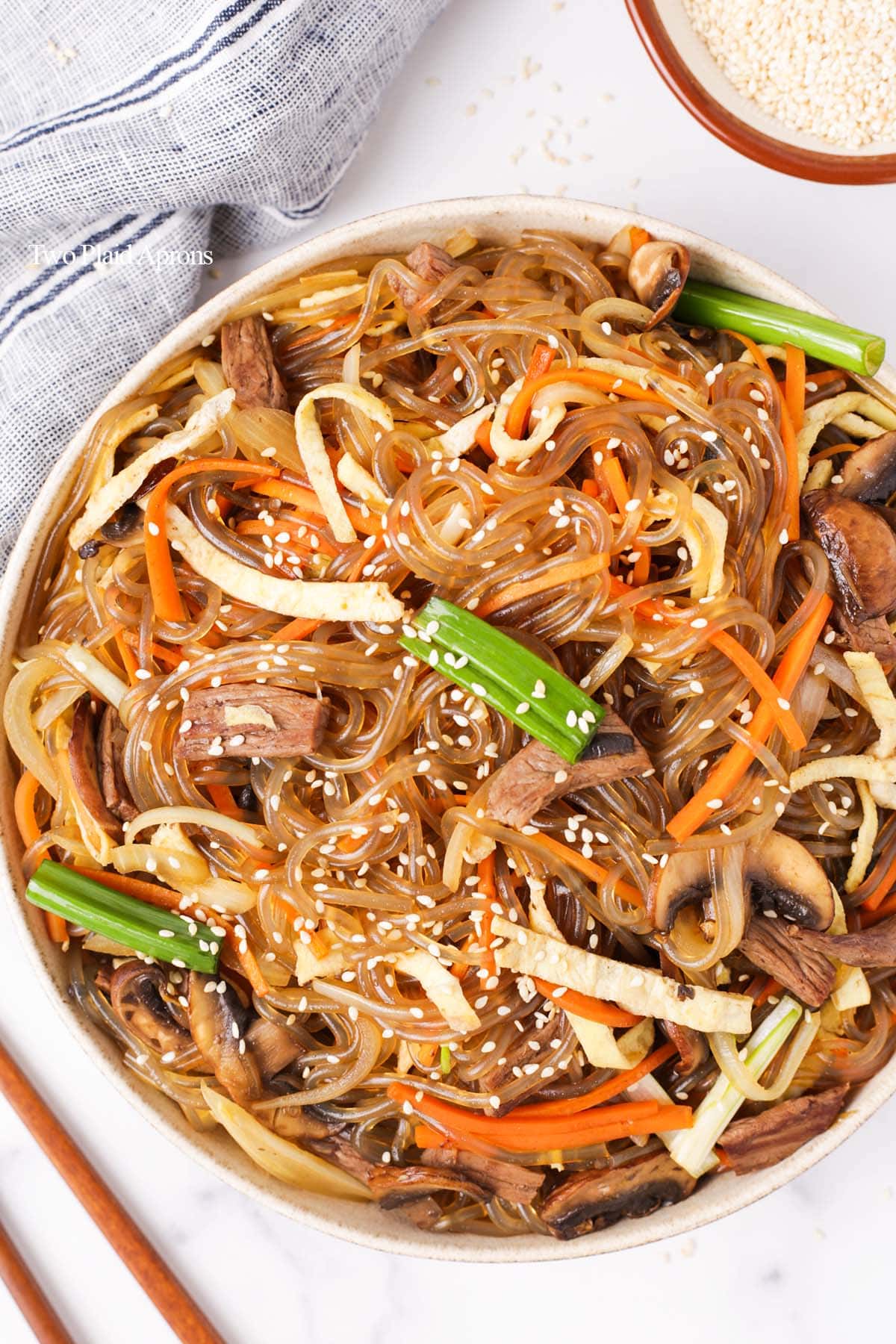
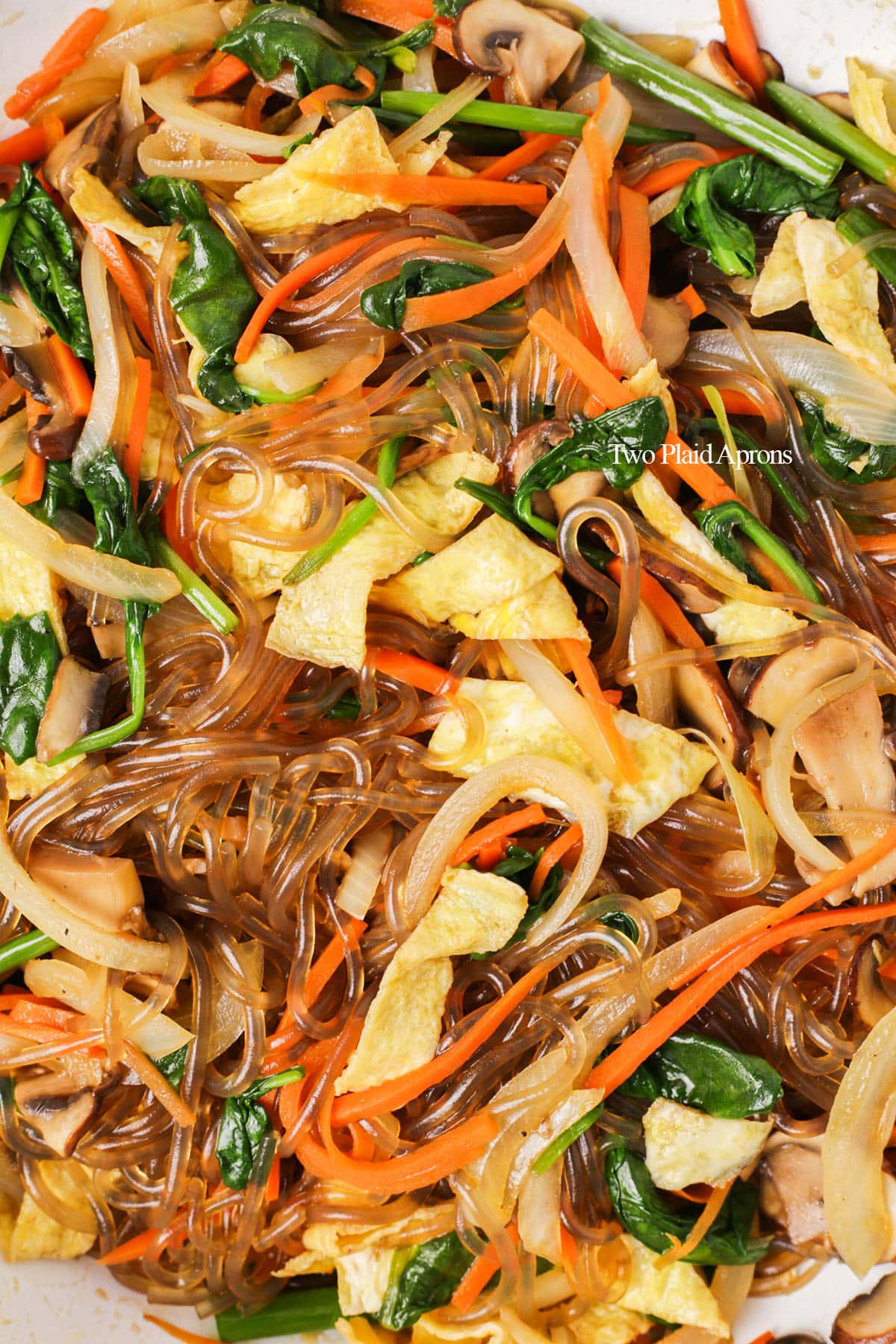
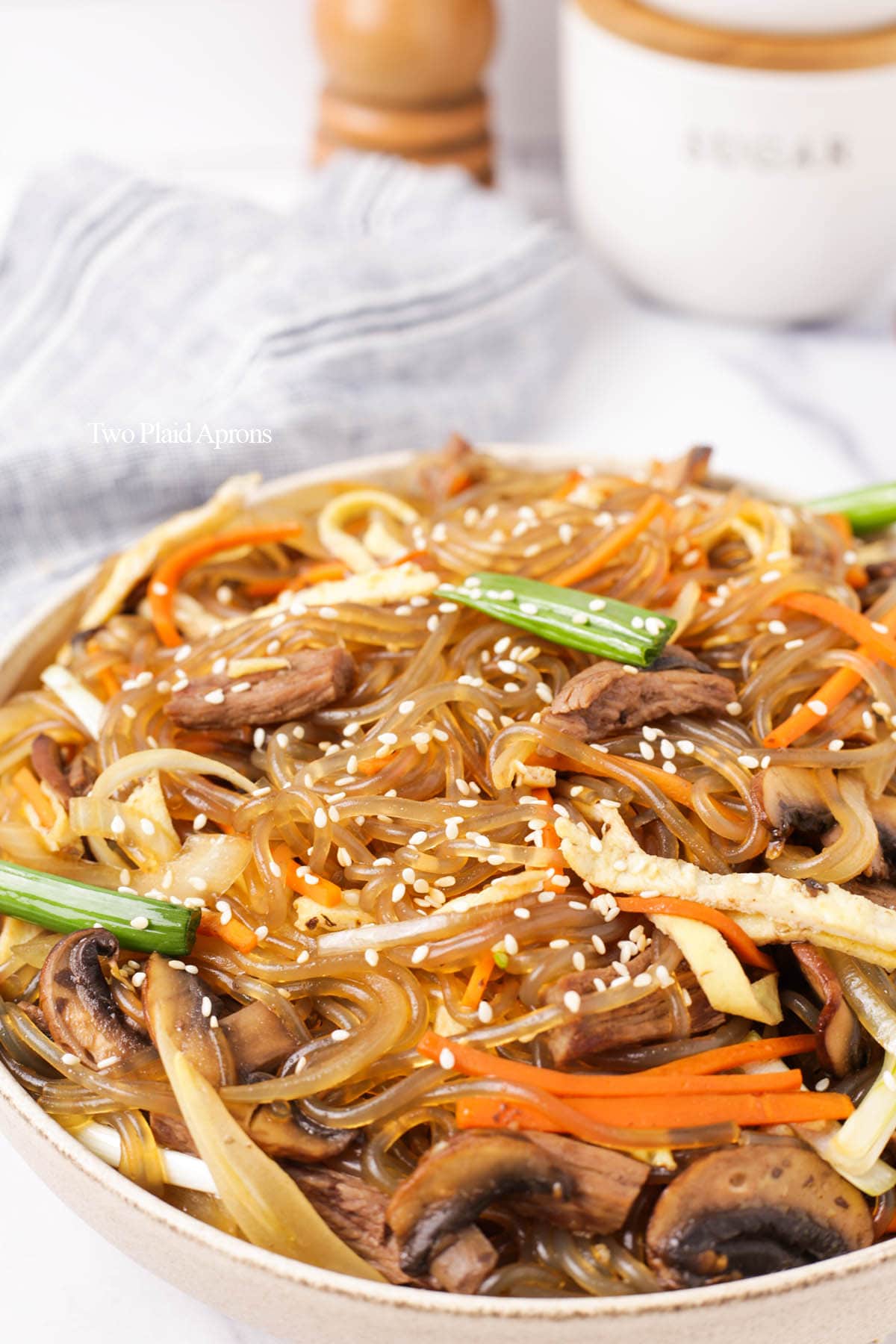
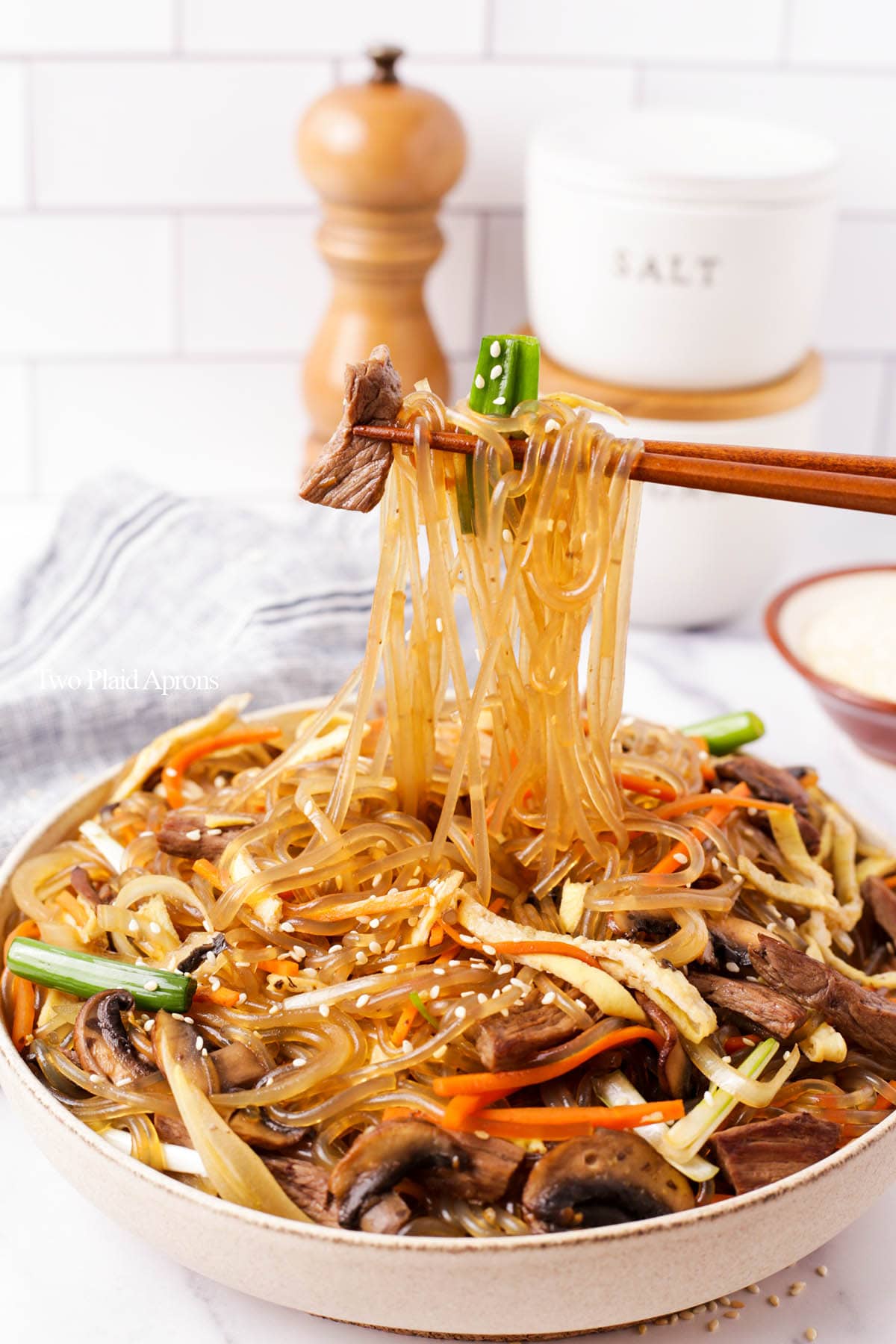
Japchae (잡채), or Korean glass noodle stir fry, is a popular Korean noodle dish that's great for holidays, special occasions, and even as everyday meals. It's made with bouncy sweet potato noodles and loaded with veggies, eggs, and optionally meat, which makes it perfect as a meal on its own or served as a side with dishes like beef bulgogi, Korean volcano steamed eggs, and dwaeji galbijjim. It's also a perfect side for Korean BBQ! Japchae recipes may seem long, but it's actually quite simple and easy to make. With it's sweet and savory flavor, japchae is a guaranteed crowd pleaser!
If you've made this recipe or any recipes from our blog, please tag us on Instagram using #twoplaidaprons! You can also tag us in your Instagram stories using @two_plaid_aprons. We would love to see your creations! It absolutely makes our day! 🥰
Jump to:
What is japchae?
Japchae (잡채), pronounced like "chob-cheh," is a Korean sweet potato glass noodle dish stir-fried with vegetables, eggs, and optionally meat. It's a popular Korean noodle dish that's often served during New Years and special occasions, but also as an everyday meals or as a side dish.
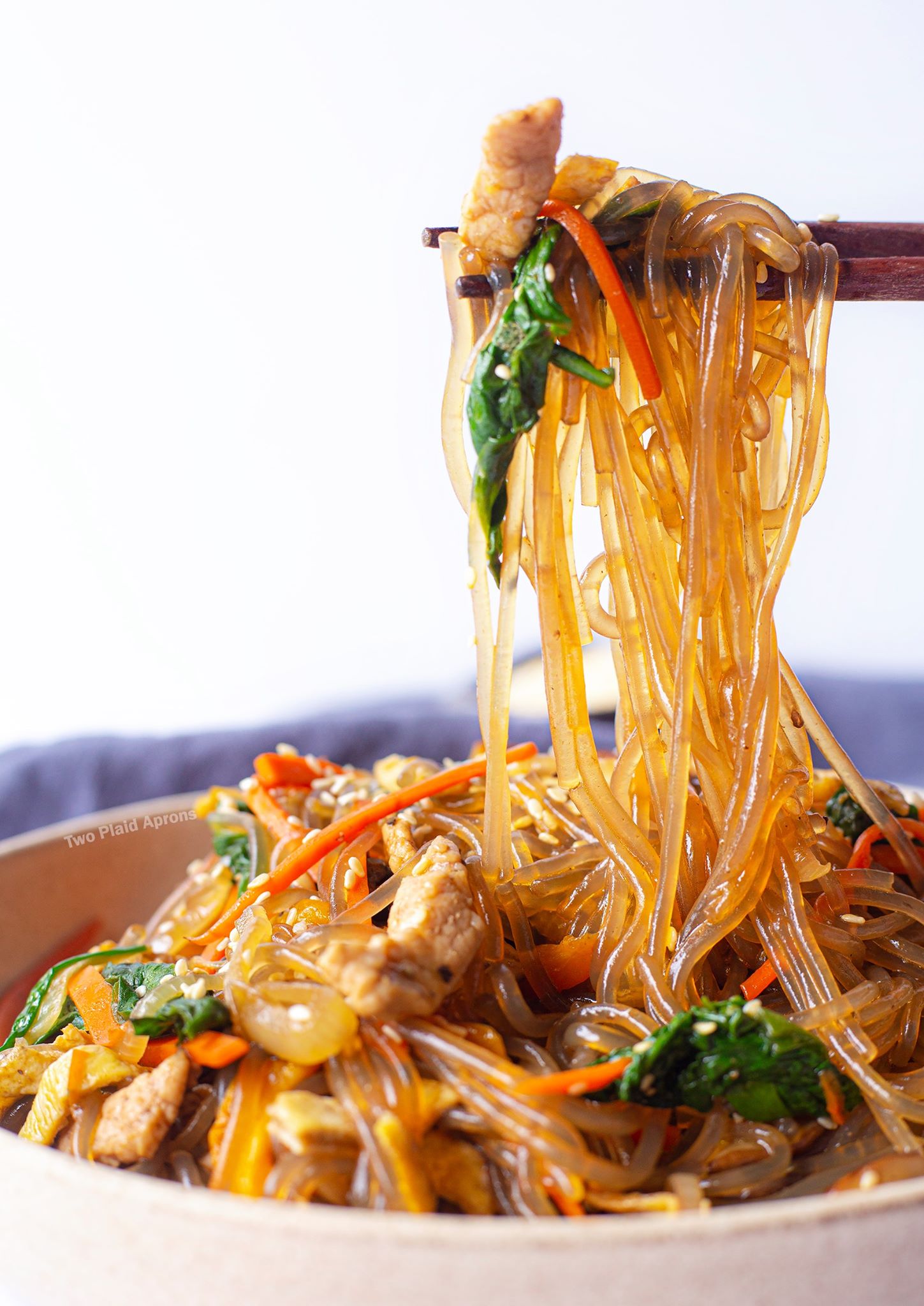
What to eat with japchae
Japchae on it's own makes a great meal, but it's even better served with other dishes! Here are a few of our favorites:
- Gochujang BBQ chicken thighs
- Traditional napa cabbage kimchi or geotjeori (fresh kimchi)
- Mandu (Korean dumplings)
- Kimchijeon (Savory Kimchi Pancakes)
- Gyeran mari (Korean rolled omelette)
Ingredient notes
Please scroll down to the recipe card for the ingredient quantities!
For the japchae:
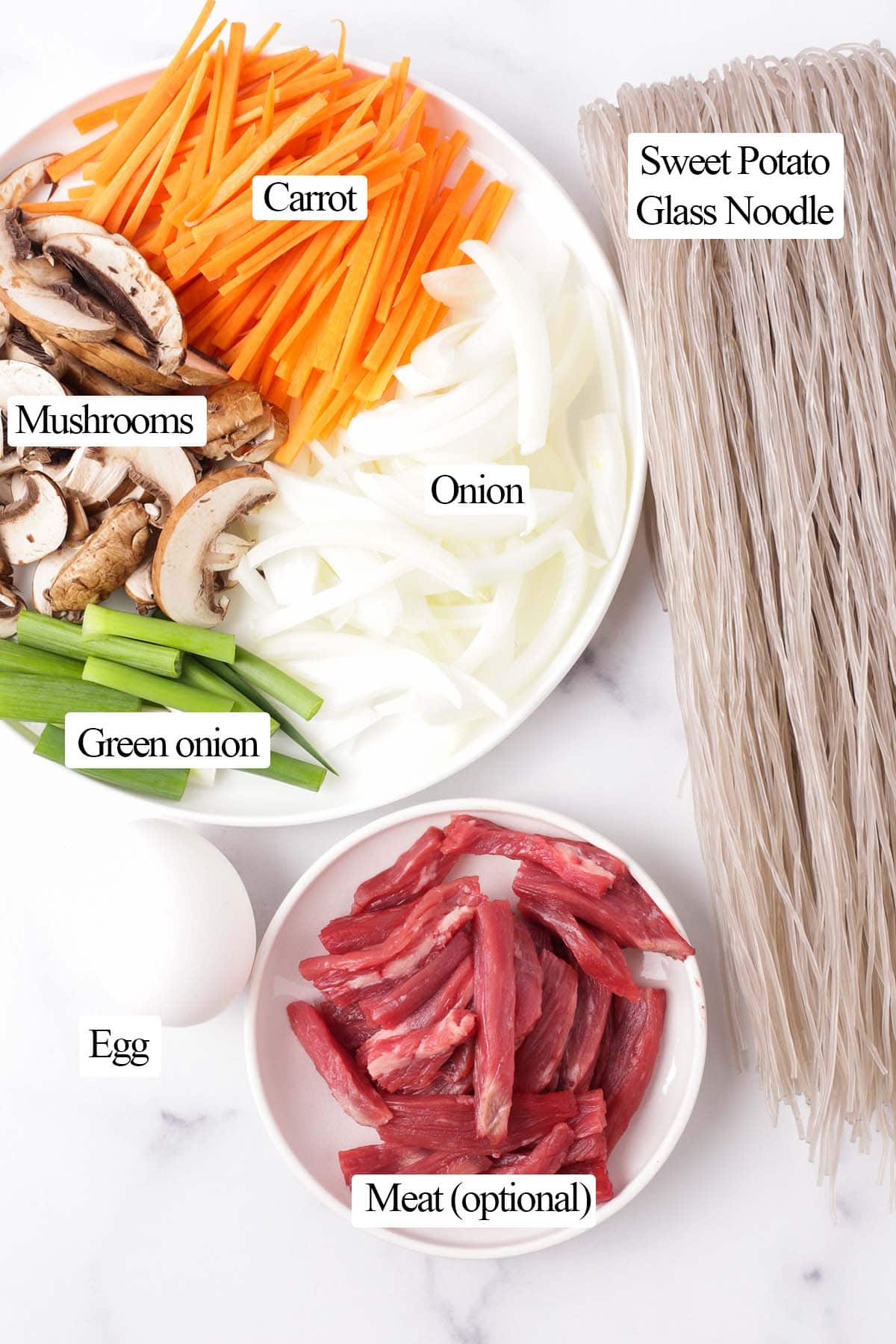
- Sweet potato glass noodles - Also known as dangmyeon. These sweet potato noodles super bouncy, chew, yet tender.
- Beef or pork - Either proteins are great for making japchae. For beef, we usually use cuts like sirloin, flank, or skirt. As for pork, we love using pork chops, loin, and pork butt. Feel free to use whatever you have. You can even use chicken or omit the protein to make it vegetarian!
- Eggs - For making egg crepes. Eggs also make japchae extra fragrant and tasty!
- Onion, carrot, spinach, mushrooms, green onion - These are the most popular vegetables used in japchae. They add both color and texture to the noodles. So feel free to use all of them, use more of one, or omit certain ones. We do recommend using at least some onions.
- Salt and pepper - For seasoning the proteins and veggies. It is important that everything is seasoned so that the final product is well seasoned.
- Toasted sesame seeds (optional for garnish)
For the japchae sauce:
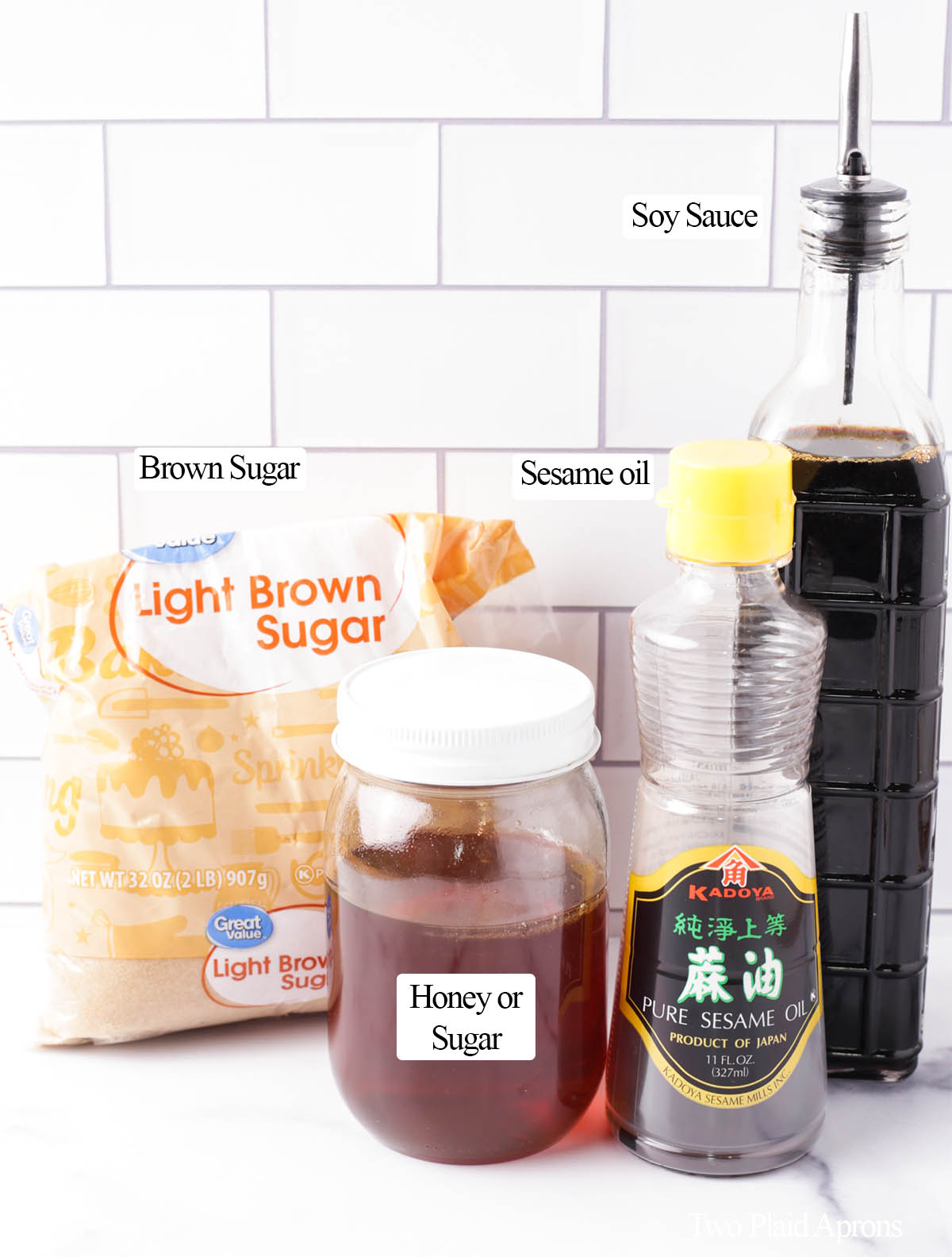
- Soy sauce - We recommend light sodium soy sauce, but regular soy sauce works too. If using regular soy sauce, use a tablespoon less per recipe. The soy sauce is not only one of the main flavorings of this noodle dish, it also gives noodles its golden brown color.
- Honey and brown sugar - A combination of honey and brown sugar makes the japchae more flavorful, but regular granulated white sugar is fine too.
- Sesame oil - This is a Korean pantry staple and adds a nice toasted, nuttiness to the dish. We highly recommend using some toasted sesame oil for japchae, but if you prefer, you can omit it.
Make it vegan or vegetarian
Japchae is easily customizable to your to your diet preference, whether vegan or vegetarian.
To make it vegetarian, the beef or pork can be omitted or replaced with tofu. If you are using tofu, make a little extra japchae sauce. Cut the tofu into strips, sear them, and let the tofu simmer in the extra japchae sauce until thick. This will give the tofu lots of flavor. Or simply just sear the tofu and add it to the japchae with the other ingredients.
For a vegan version, omit the beef or pork and eggs. The honey in the japchae sauce can be replaced with more brown sugar or white sugar. Extra vegetables can also be added to help bulk up the japchae.
How to make japchae
Please scroll down to the recipe card for the full recipe and instructions!
Prepare the ingredients:
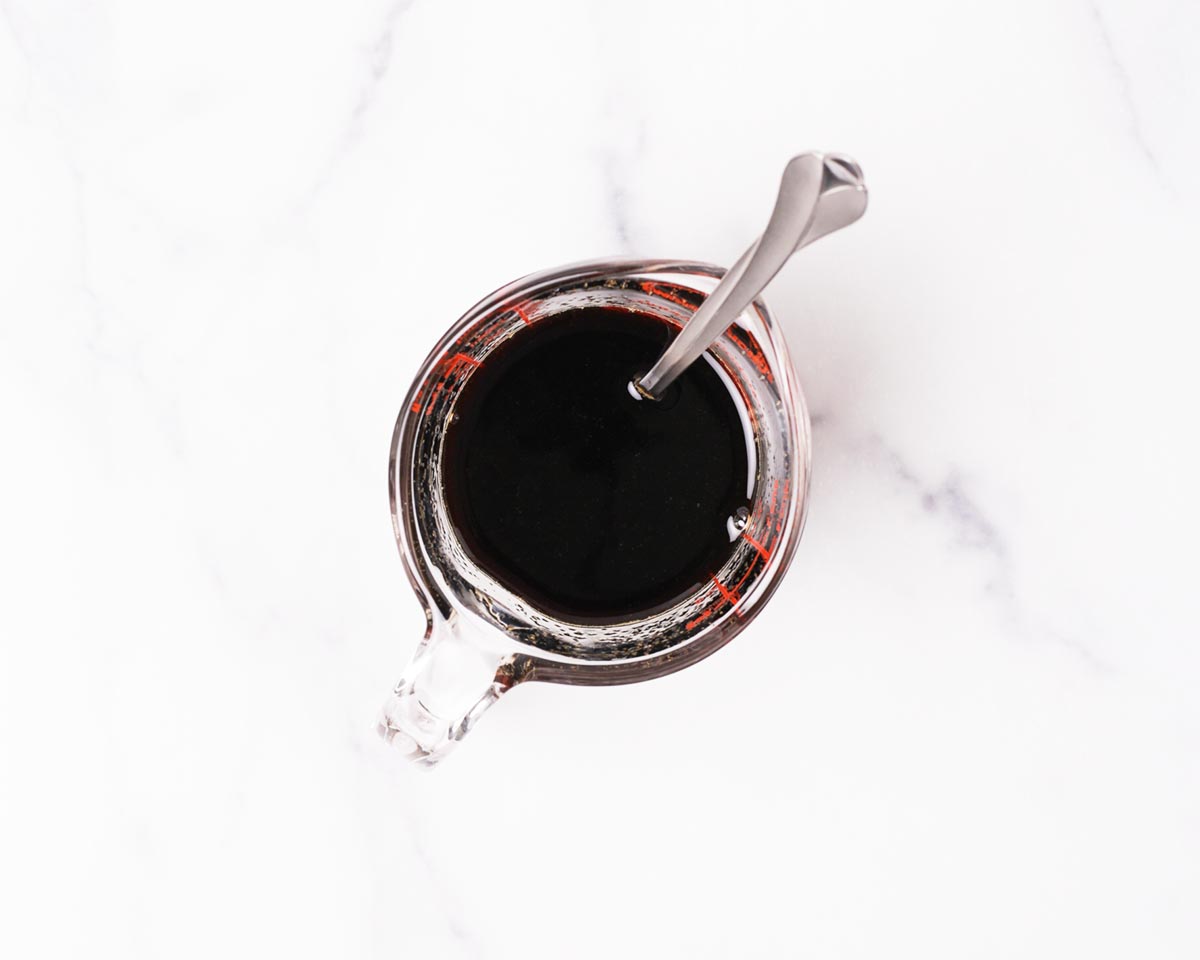
1. Prepare japchae sauce. Combine the ingredients for the japchae sauce. Mix well and set aside until needed.
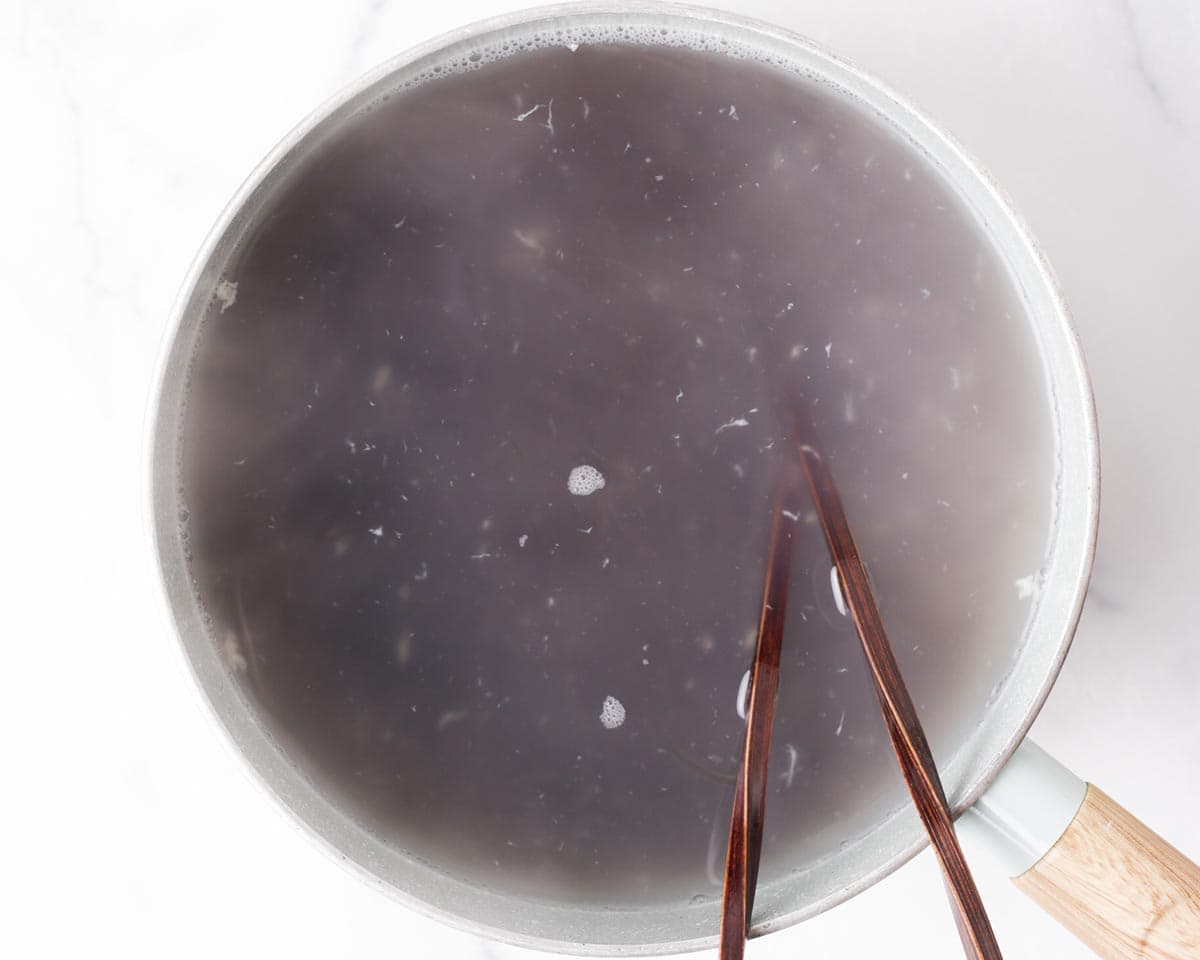
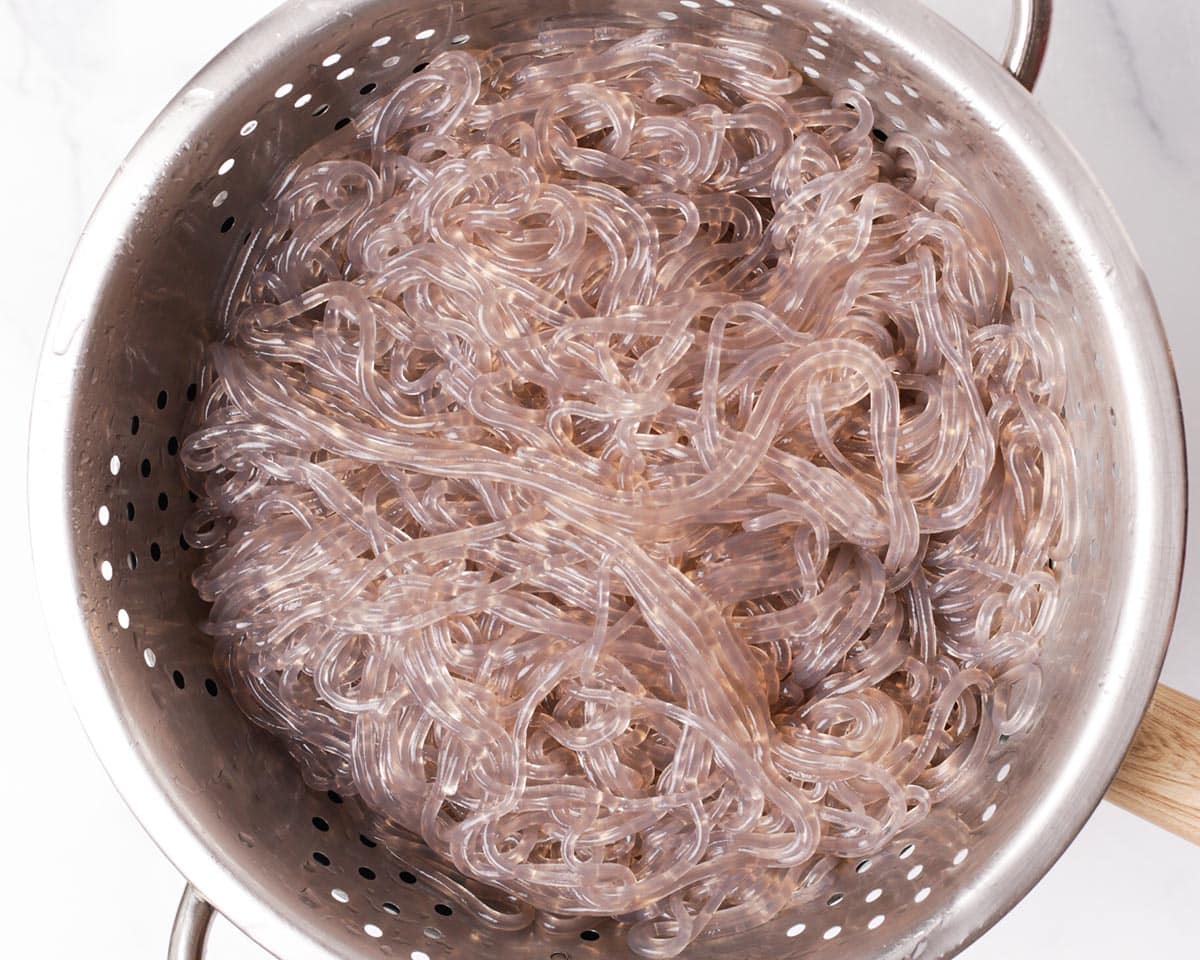
2. Cook the noodles. Boil the sweet potato glass noodles in a pot of boiling water for 10 to 15 minutes, or until just cooked. The cook time will vary, depending on the brand. Drain the noodles and rinse with cold water until completely cooled. Set aside until needed.
3. Prepare the egg. Add a small amount of oil to a large nonstick pan over medium heat. When the pan is hot, add the beaten egg. Tilt the pan to spread the egg into a thin layer.

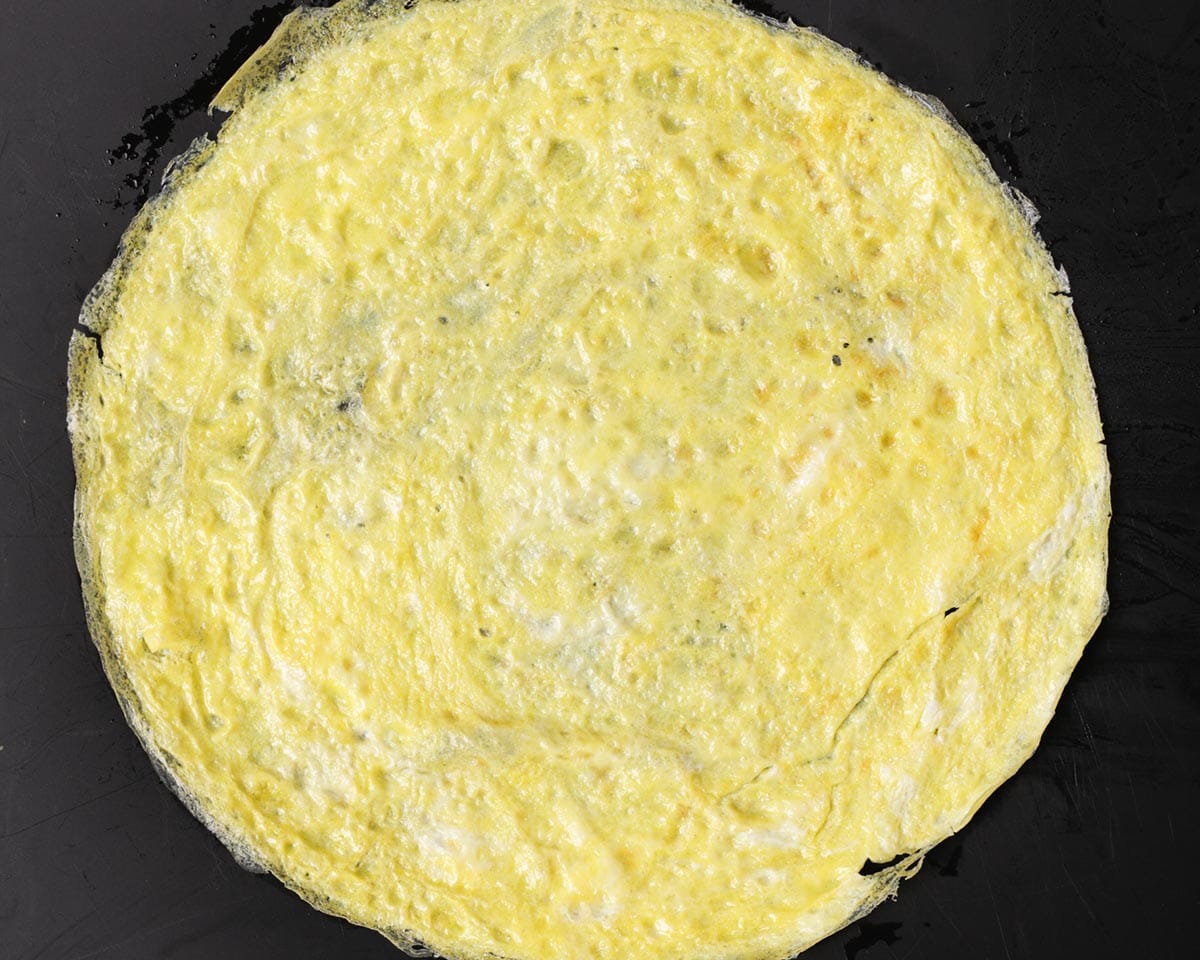
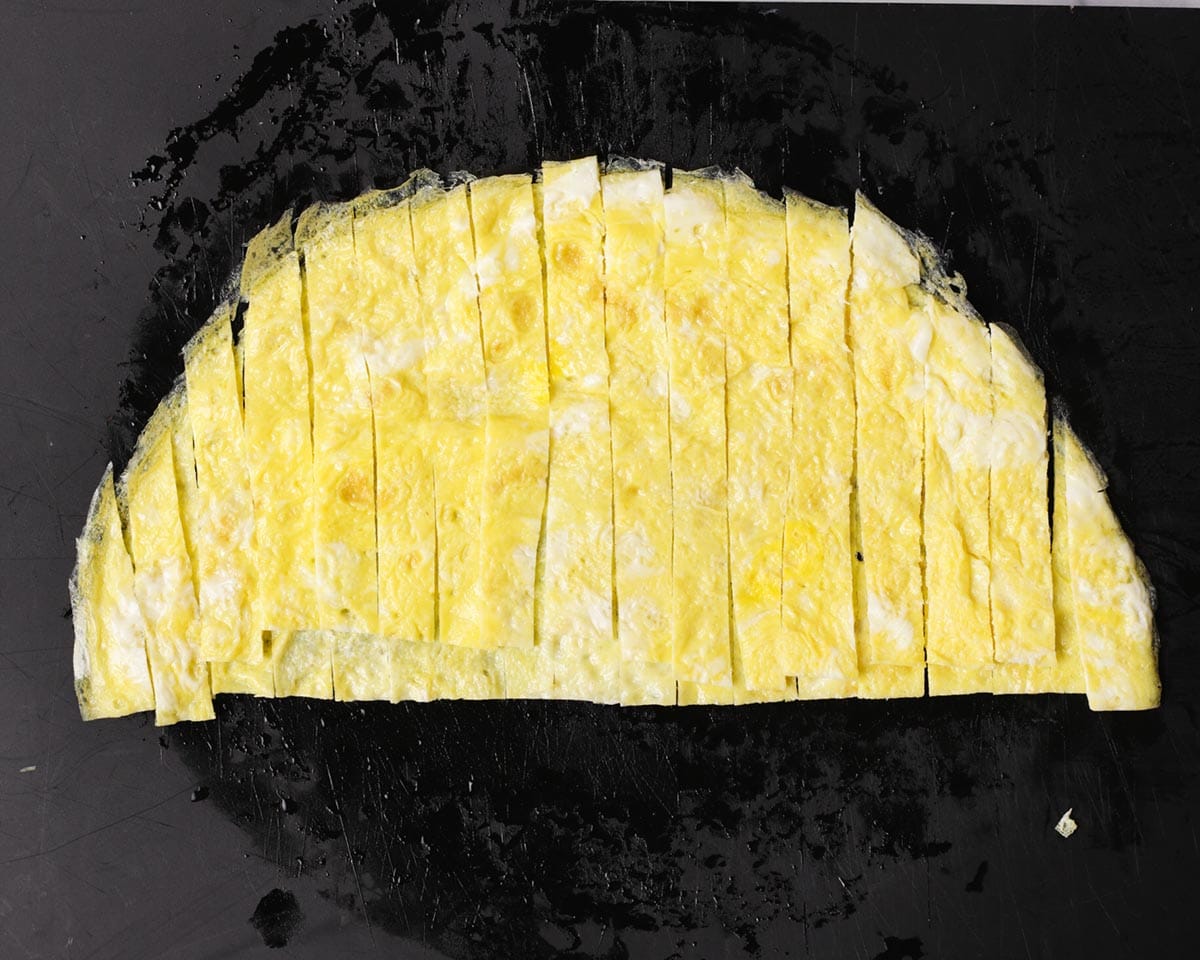
Cook until the bottom of the eggs are set, then flip to cook the other side briefly. Remove from the pan to cool. Once cooked, fold it in half and cut into ¼ inch strips.
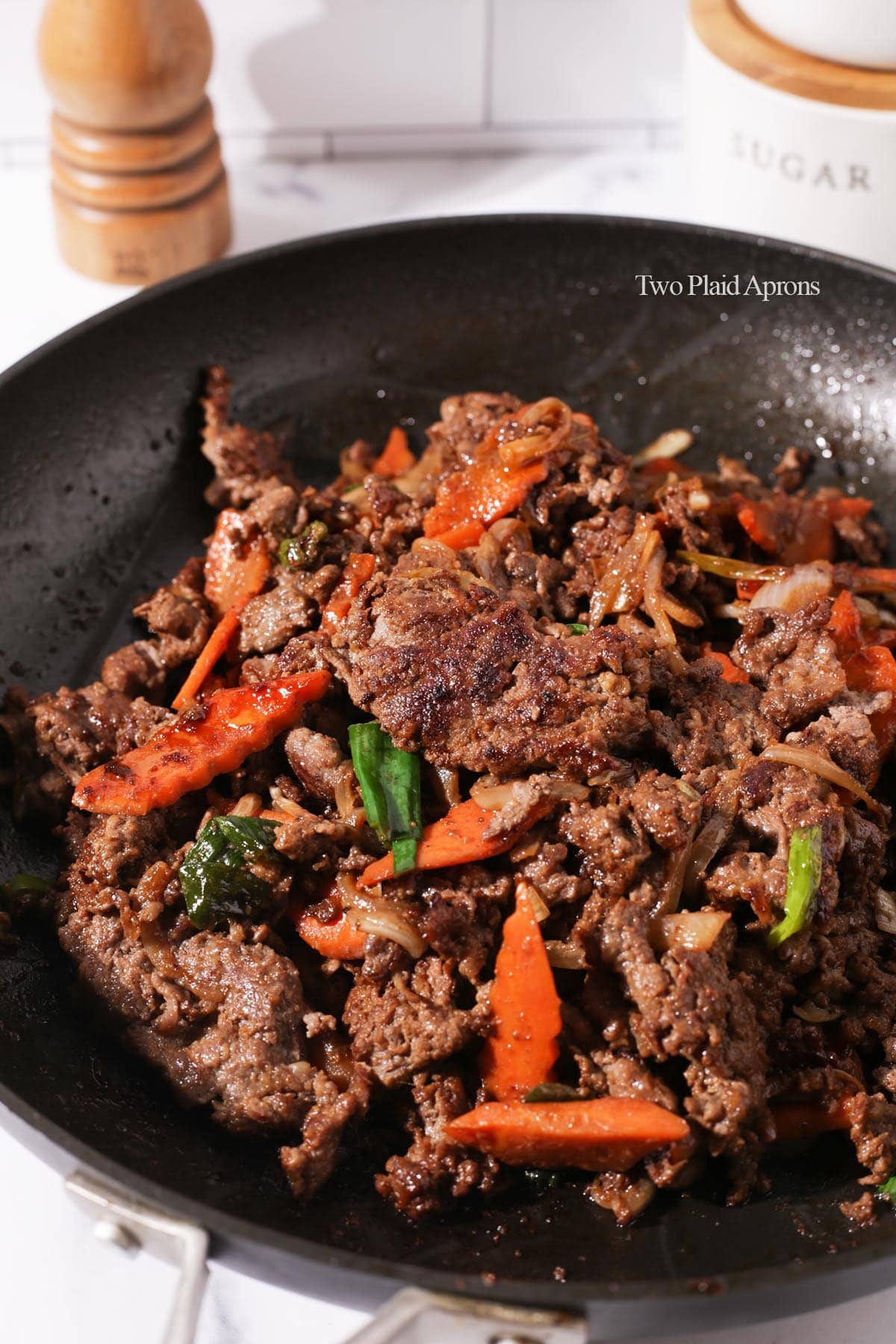
4. Sear the beef or pork. Add a small amount of oil into the same pan over medium high heat. Add the beef or pork and season with a pinch of salt and a few cracks of black pepper. Sear the meat on each side until cooked. Remove and set aside.

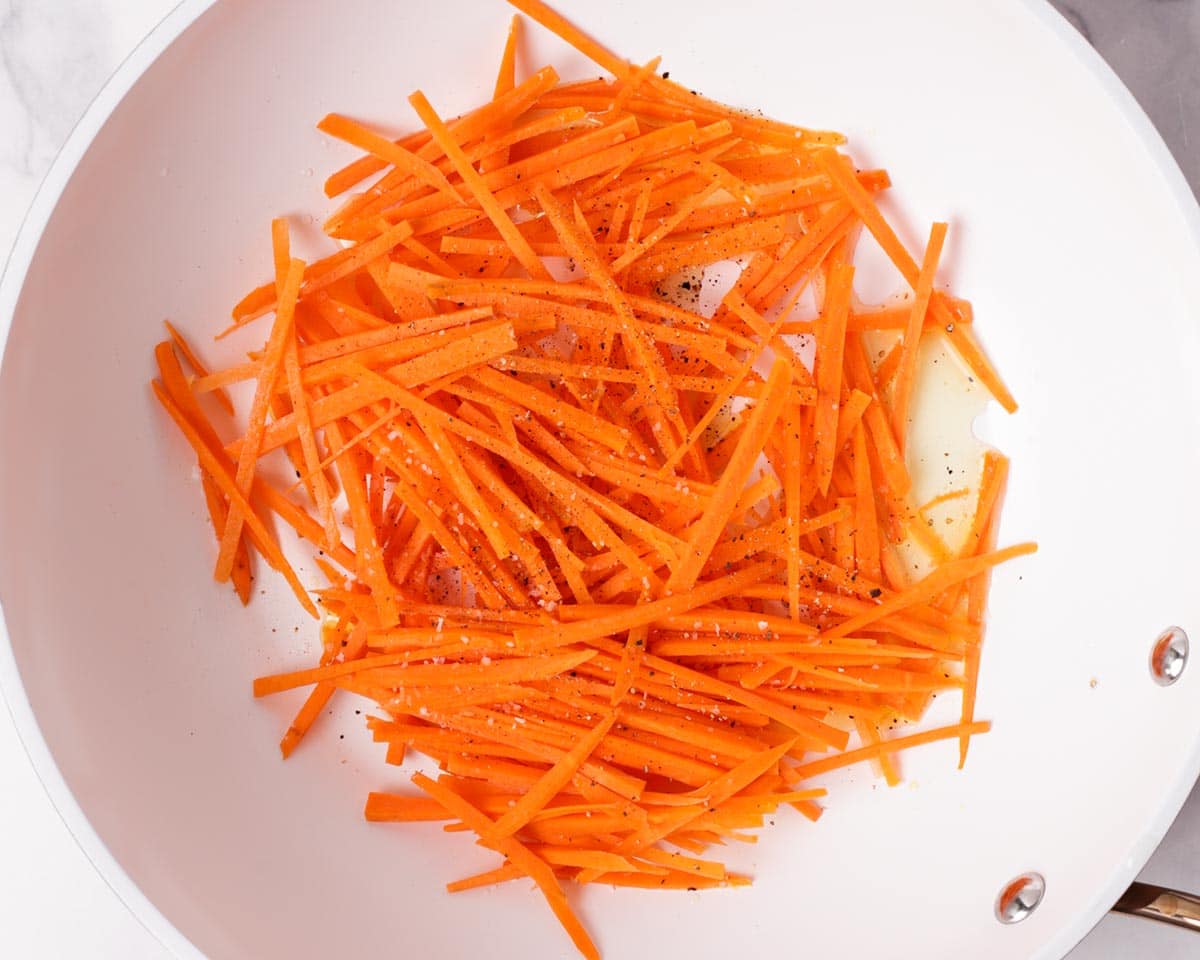
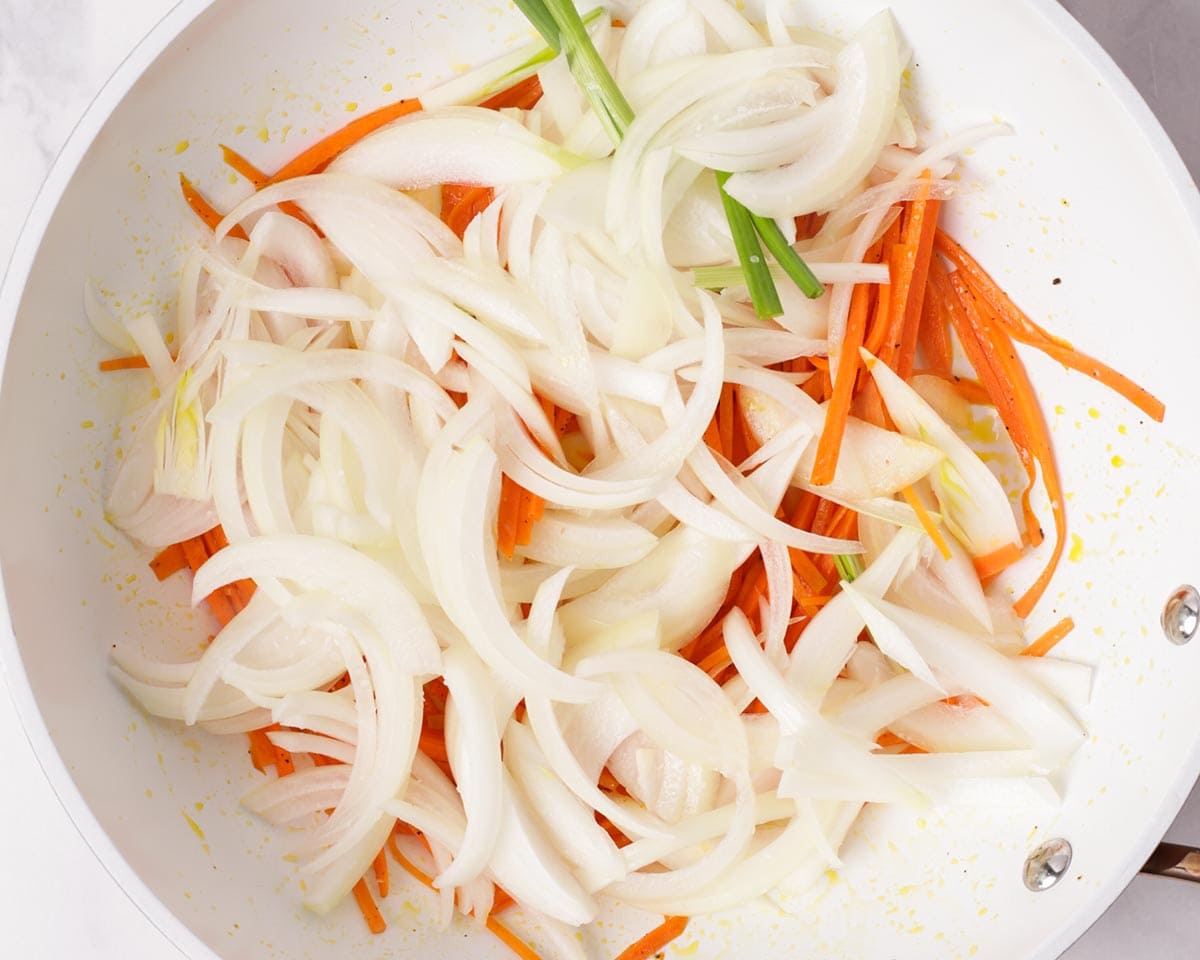
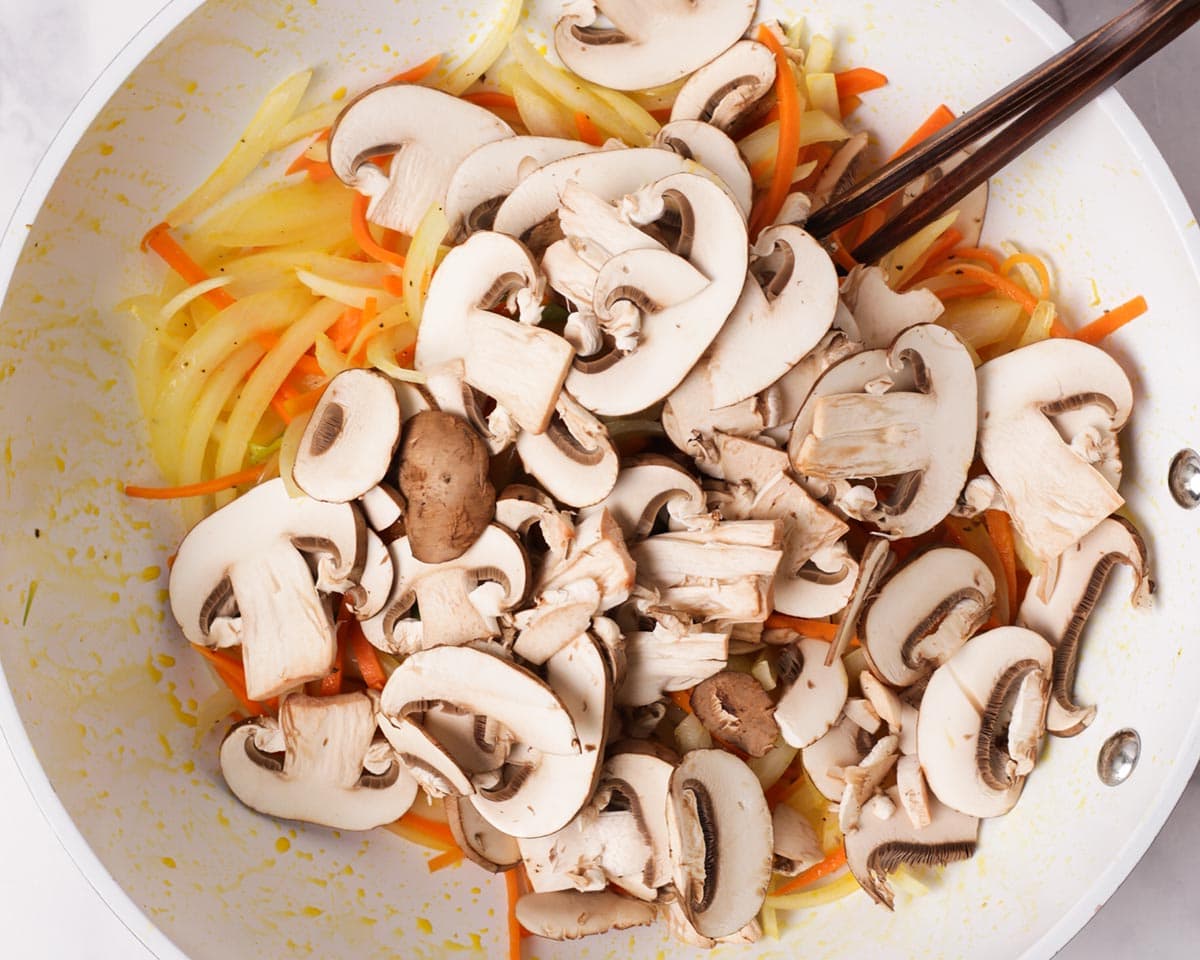
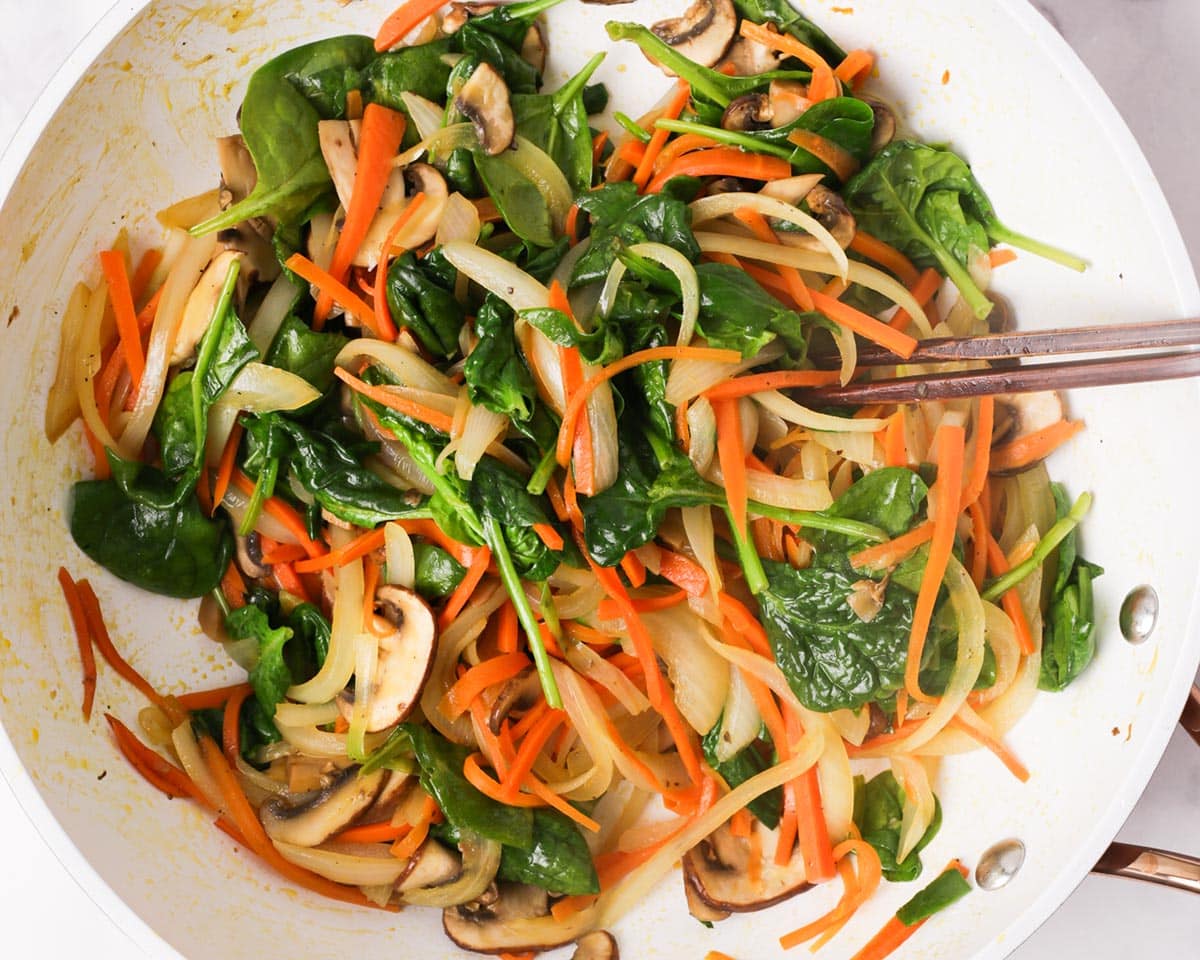
5. Cook the vegetables. In the same pan over medium high heat, add some oil and cook the vegetables according to heartiness, until they are cooked but still with texture. Season the veggies with some salt and black pepper. Set aside.
📝 For example: Cook the julienned carrots first. Then add the onions and green onion bottoms, followed by mushrooms, then spinach. Cook each vegetables for about 10 to 30 seconds, depending on their heartiness.
Finish the japchae:
6. Heat up japchae sauce. Into the same pan, add the prepared japchae sauce and heat over medium heat. Stir occasionally until the sugar has dissolved. Reduce the heat to low.
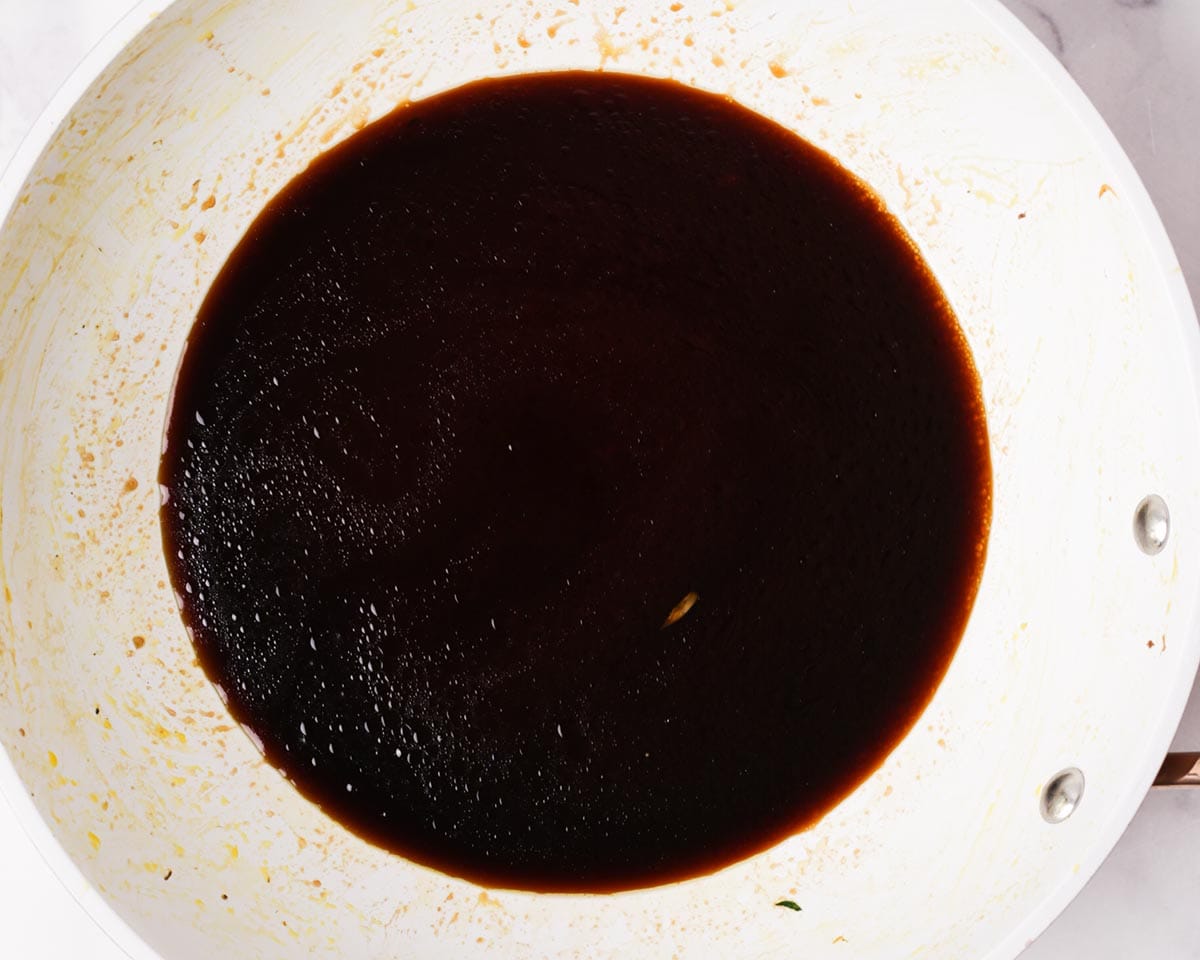
7. Assemble. Add the sweet potato noodles to the sauce and mix until well coated.
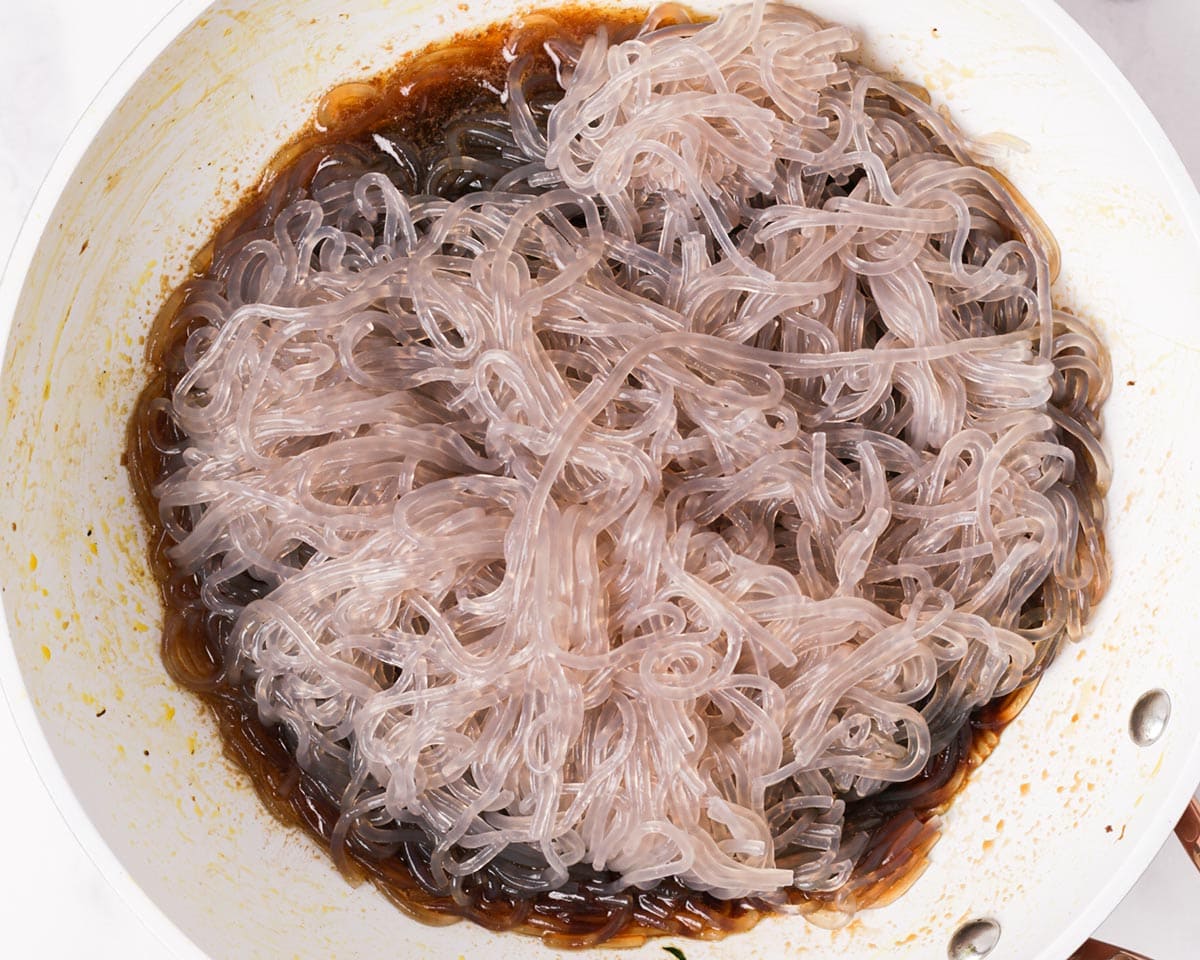
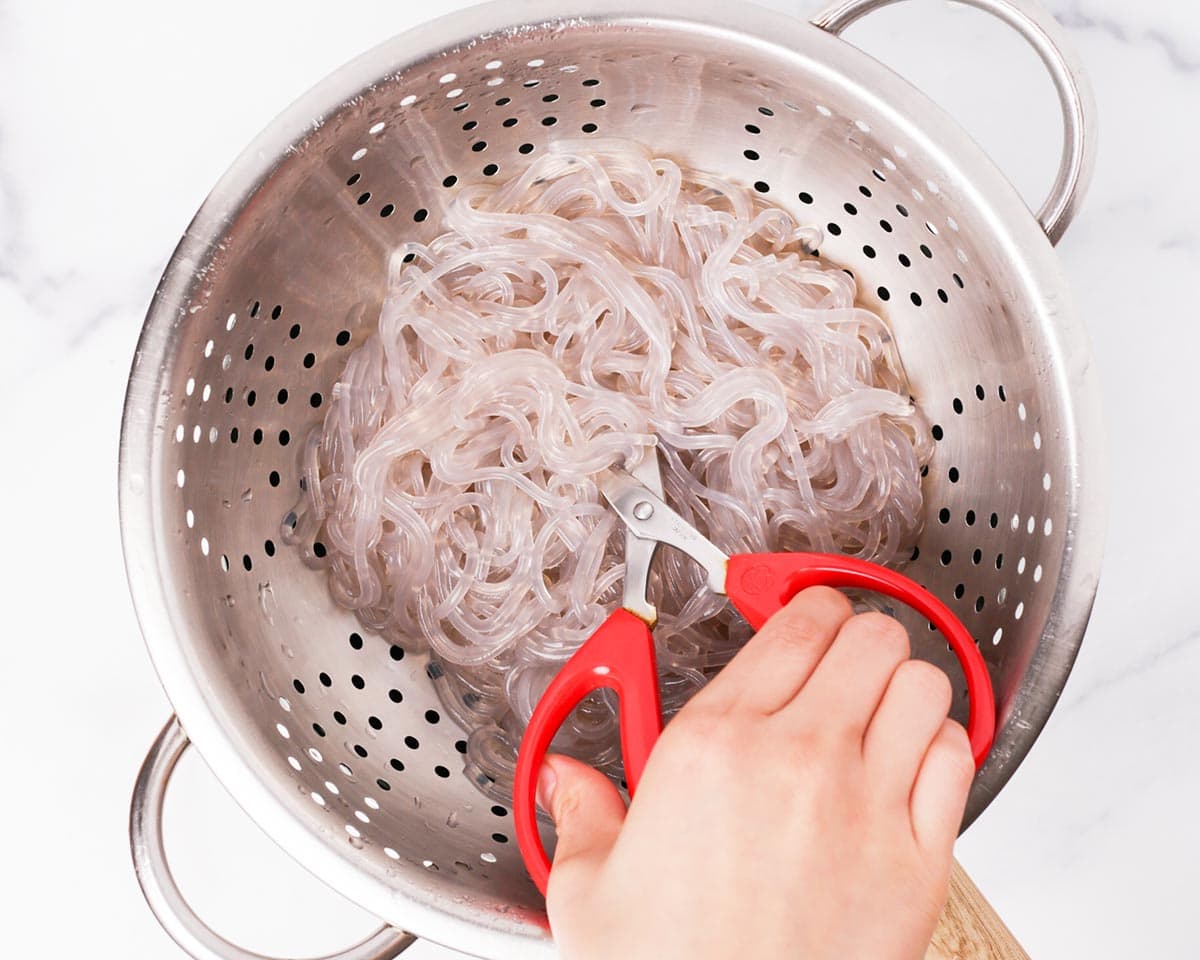
🌟 Pro tip: Cut the sweet potato noodles into shorter strands before adding to the sauce for easier eating.
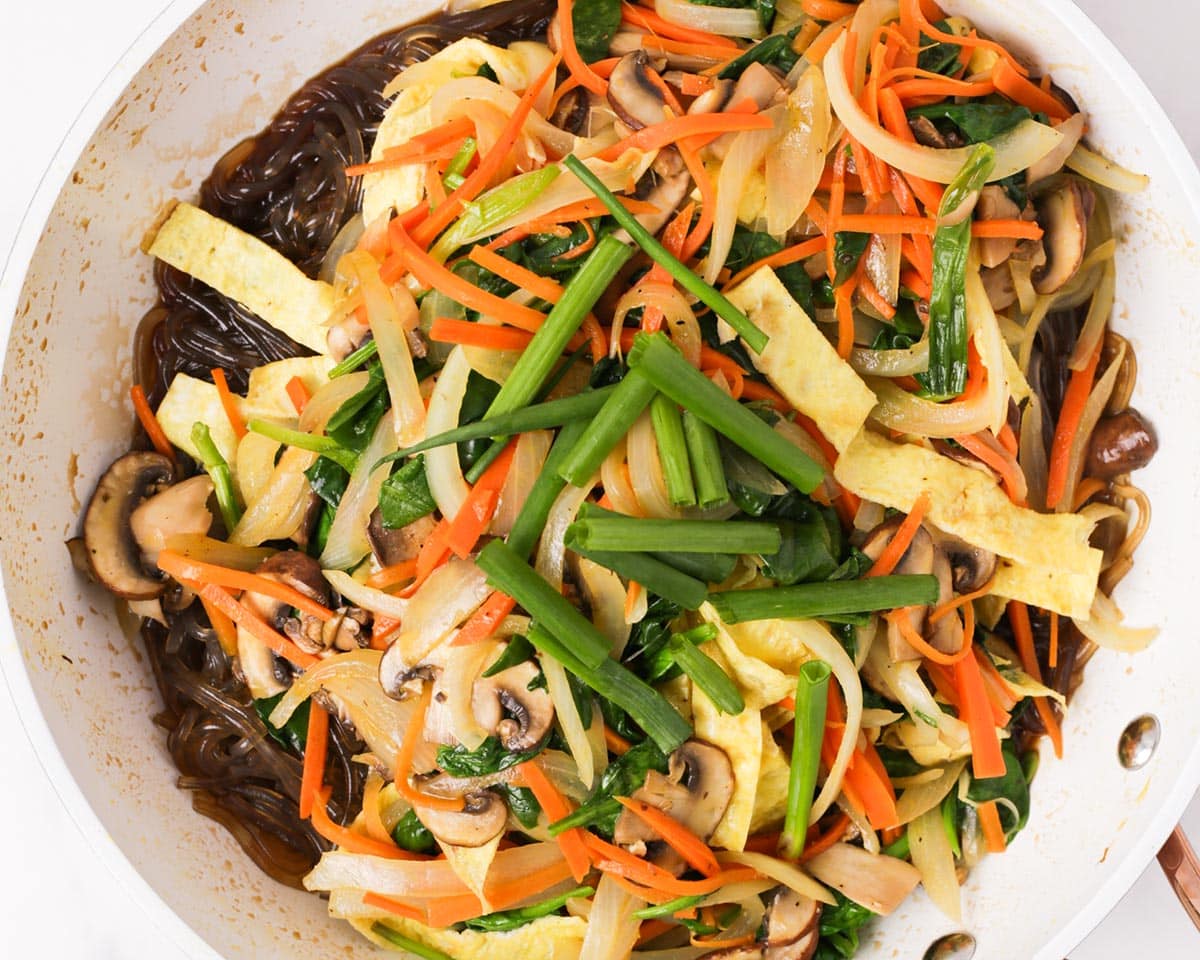
Add the rest of the japchae ingredients and toss until everything is well combined. If you prefer your japchae warmer, let the japchae cook a little longer, until warmed through.
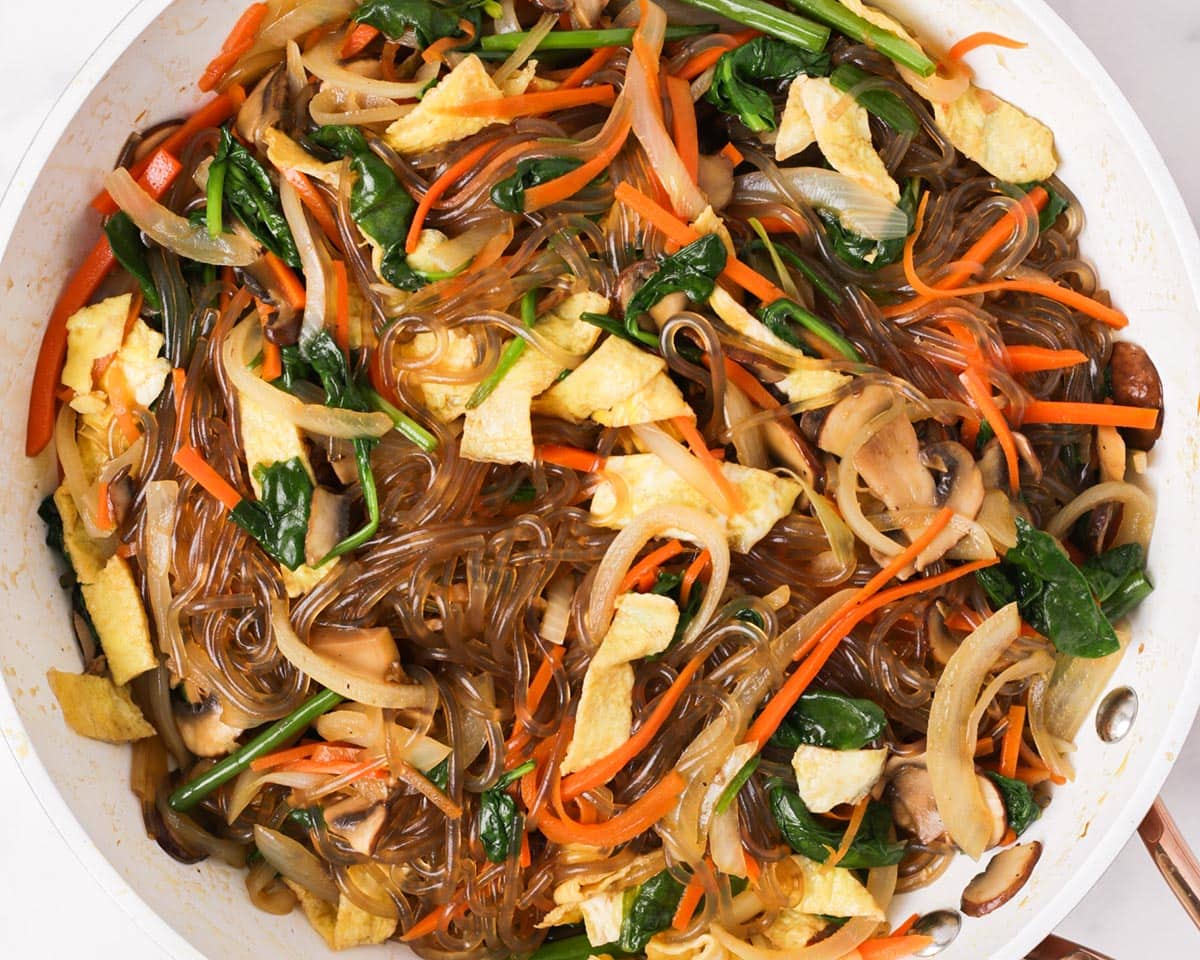
8. Serve. Portion the japchae or serve it family style with a sprinkle of sesame seeds. Enjoy!
Recipe tips
- Don't over cook the noodles! It is very important to not overcook the sweet potato noodles to prevent so that the noodles are bouncy, not mushy.
- Rinse the noodles in cold water. After draining, make sure to thoroughly rinse the noodles in cold water until they're completely cooled. This is to remove excess starch and to keep the noodles bouncy and chewy.
- Drain the noodles well. Before adding the rinsed sweet potato noodles into the japchae sauce, make sure the noodles are very well drained so that the sauce doesn't become diluted.
- Cut the noodles after cooking for easier eating. We highly recommend cutting the sweet potato noodles into shorter strands using a pair of kitchen shears so that it's easier to eat.
Storage
Japchae makes for great leftover meals. To store, let the japchae cool completely before storing in an airtight container, in the fridge, for up to 2 to 3 days. Note that after a couple of days, the noodles will start to lose its bouncy texture.
Reheating
Japchae can be easily reheated in the microwave or on the stovetop. If you'd like, you could enjoy the noodles chilled as well.
Microwave method: Place the japchae into a microwave-safe container and cover loosely. Microwave until warm or hot, giving the noodles a mix midway through for even heat distribution.
Stovetop method: Add the leftover into a pan over medium heat, along with a small amount of water. Gently mix the noodles until warm and the water evaporates.
FAQ
A good japchae should have bouncy, slightly chewy noodles and is well balanced between sweet and savory with a hint of toasted sesame oil. The vegetables should have texture but not raw.
Japchae can be served hot, cold, or at room temperature. However, we recommend enjoying the noodles while they are are hot or room temperature because the flavors are fuller and more well rounded.
Depending on the brand of japchae noodles, the cook time could vary. But typically japchae noodles take about 10 to 15 minutes to boil.
To check if the sweet potato noodles are done, pinch off a piece of noodle. If it breaks off easily, it's done. Also, you can check to see if the center of the noodles are clear or if they still look slightly white and starchy. White and starchy means the noodles need to be boiled a little longer.
📖 Recipe
Japchae (Korean Glass Noodle Stir Fry)
Ingredients
For the japchae:
- 12 ounces sweet potato glass noodles
- 16 ounces beef or pork cut into strips (cuts like flank, skirt, ribeye are great; you can use pork instead too)
- 2 large egg beaten
- 1 large carrot peeled and julienned
- 1 medium yellow onion thinly sliced
- 3 mushrooms thinly sliced (any mushrooms of your choice)
- 2 cups baby spinach packed
- 2 stalks green onion cut into 1 inch pieces
- oil for cooking
- Toasted sesame seed (optional for garnish)
- Salt and black pepper as needed
For the japchae sauce:
- 7 tablespoons soy sauce light sodium
- 3 tablespoons honey (or use more brown sugar)
- 2 tablespoons brown sugar (light or dark)
- 2 tablespoons toasted sesame oil
Instructions
- Make the japchae sauce:Mix together all the ingredients for the sauce and set aside.
- Cook the japchae (sweet potato) noodles:In a large pot of boiling water, add the japchae noodles and boil until the noodles are cooked through, about 10-15 minutes depending on the brand. Stir occassionally to prevent the noodles from sticking.
- Once the sweet potato noodles are cooked, drain it immediately and rinse thoroughly with cold water until completely cooled. Drain the noodles well and set aside.Optional: Use a pair of kitchen sheers to cut the japchae noodles into shorter pieces for easier of eating.
- Make the egg crepe:In a large nonstick pan over medium heat, add a small amount of oil. When the oil is hot, pour in the beaten eggs. Tilt the pan to spread the egg into a thin layer and cook until the egg crepe is set on the bottom. Flip the egg crepe and and cook the other side briefly. Remove from pan and let it cool until comfortable to handle.
- Once the egg crepe has cooled, fold it in half and cut the egg crepe into thin strips. Set aside until needed.
- Cook the beef (or pork):In the same pan over medium high heat, add a small amount of oil. When the oil is hot, add the beef and lightly season with some salt and pepper. Sear the beef until golden brown and cooked through, about 4 to 5 minutes. Remove from pan and set aside.
- For the vegetables:In the same pan over medium heat, add a small amount of oil. Sauté the vegetable according to their heartiness*. Between each addition, season the vegetables lightly with salt and black pepper. Cook the vegetables just until they become tender. Then, remove from pan and set aside.*For example: Add the carrots first and sauté for 15 to 30 seconds .Then add the onions and green onion bottoms, followed by mushrooms, then spinach, and lastly the green onion tops.*
- Assemble the japchae:In the same large pan or a stir fry pan over medium heat, add the prepared japchae sauce. Stir the sauce occasionally until the sugar is completely dissolved and the sauce is starting to bubble. Turn the heat to low.*You can also place all the ingredients into a large mixing bowl for easier tossing.*
- To the sauce, add the japchae noodles and mix until the noodles are evenly coated. Then, add the rest of the prepared ingredients (vegetables, beef or pork, and egg strips). Toss until everything is evenly combined and remove from heat.
- Serve:Portion the japchae or serve it family style with a sprinkle of sesame seeds. Japchae can be enjoyed hot, warm, room temperature, or slightly chilled.
Notes
- Feel free to omit, substitute, and add vegetables to to this recipe. Japchae is very customizable and will taste just as good!


Ruthie says
I made jap chae for the first time and followed your recipe pretty much exactly. I did marinate the meat in some soy sauce, garlic, ginger, rice wine, and goichichun paste for a few hours. I made a triple batch for hubby’s game night and was expecting a little bit of leftovers but there were none. Except for me it was w retinues first time eating jap chae and they want me to make it again. Thanks for the great recipe!
Mei says
Hi Ruthie!
Thank you so much for trying our japchae recipe! So good to hear that everyone enjoyed it!
Cook with love!
Mei ❤️
Jessica says
Where did you find the noodles at? I can’t find them anywhere!
Mei says
Hi Jessica!
These sweet potato glass noodles are usually available at most Asian markets. There are many different brands but you can usually recognize them by their grey-ish color, and they're usually labeled as "sweet potato [starch] noodles". If you can't find them at your local Asian market, click here to order them online. I've also provided links for the japchae noodles in the post and the recipe ingredient list (the text with links are pink).
Hope this helps!
Cook with love!
Mei ❤️
jane says
hello! is the 613 calories for the whole dish (as in 3 servings so like 200 calories per plate)? or is it 613 for 1 of those 3 servings?
Mei says
Hi Jane!
The japchae recipe makes about 6 servings and the calorie count and nutritional label is based on 1 serving of japchae. Most of the calories come from the sweet potato noodles and the pork. Also, I did a small update on the recipe, so one serving of japchae is now 417kcal. So 417kcal for 1 of 6 servings =)
Hope this answered your question!
Mei
Vaibhavi says
Your videos are what I watch everyday to unwind. I go to sleep comforted and knowing what I want for dinner the next day. The recipes are clear and easy to follow. I love how you say use whatever is available when possible. It makes the task seem less daunting. You guys help me feel like I can make scrumptious, hearty and tasty food at home.
The noodles were a hit! Loved it with some radish kimchi. Perfect side since the salty and spice cuts through the sweetness.
Mei says
Hi Vaibhavi!
Thanks for dropping us such a sweet comment! You've totally made our day and we're so happy that our videos bring you comfort! And can't agree more! Radish kimchi is so good with everything, especially japchae =)
Mei ❤️
Mai says
Followed recipe as written, was so great! I was worried it would be too sweet but the sweetness was well balanced and not overpowering. Thanks!!
Mei says
Hi Mai! So glad to hear that you enjoyed the japchae! Haha, totally understand why you feel doubtful about the amount of sweetener used 😆
Mei ❤️
Darrelynn says
It was very fun to make and it came out delicious . I wish I can add a photo, to show how it came out.
Mechthild says
sehr leckeres und schnelles rezept. mein sohn (19) hat es heut gekocht, allerdings mit mie-nudeln. das wird es definitiv häufiger geben.
jetzt muss ich nur noch lernen, wie man mit stäbchen isst😂
Mei says
Hi Mechthild!
We're so happy to hear that you enjoyed it! What a sweet son you have =) Practice makes perfect. I'm sure you'll perfect eating with chopsticks in no time!
Mei ❤️
Tamara says
I made this for dinner tonight and it was perfect! I changed up the vegetables based on what I had in the fridge and it was very tasty! Thanks for sharing this great recipe!!!
Mei says
Hi Tamara!
Thank you for trying out our Japchae recipe! We're so happy that you enjoyed it =)
Mei ❤️
Jessica says
Hi! Could I do more honey in place of brown sugar?
Mei says
Hi Jessica!
If you prefer, you could use more honey instead of sugar if you wish. However, the honey flavor may become more pronounced. If you don't mind that, then it is absolutely okay =)
Mei ❤️
Carla Roberts says
Hello love your recipes however would love to get more fiber in…any suggestions?
Mei says
Hi Carla!
For most recipes, like our Japchae recipe, you can simply use more fiber rich vegetables so that you can intake more fiber. Also, depending on how much extra vegetables you're adding, you may need to use a little less noodles or make a little more sauce. Hope this helps =)
Mei ❤️
Mary says
Is it OK to use canned/frozen vegetables or others that aren't typically used in a traditional japchae (e.g., frozen corn, peas, and carrots, canned mushrooms)? I can see this as a great way to use up leftovers I also see cooking/combining food in soups/stews or japchae as a good way to make sure you don't have to throw out unused and expensive food. Thank you for making accessible recipes. Cheers!
Mei says
Hi Mary!
Yes, totally agree! Japchae is a great and versatile recipe that you can customize however you want and make it a clean-out-your-fridge sort of dish. As long the flavor pairs well with the sauce, there's no issue at all. As for frozen and canned veggies, you can definitely use them without issues. The only thing to note is that you may want to avoid veggies that are very tender and may break apart (unless you don't mind it). You may not even need to cook canned veggies. Also, take notes on whether the canned veggies are already salted/seasoned. Hope this helps!
Mei ❤️
Tawnya says
Excellent and easy to read recipe! So tasty and flavorful. Really enjoy the glass noodles. Thank you!
Mei says
Hi Tawnya! So glad to hear that liked our recipe and enjoyed the japchae =)
Mei ❤️
Isabel says
I totally enjoy this dish a lot. I’ll definitely make this one again but would it work with different types of noodles. My kids (picky as heck) wasn’t digging the texture of the noodles. But I loved everything about it!
Mei says
Hi Isabel! So glad you liked the japchae recipe and totally understand that the noodles may be challenging in terms of texture. We've never tried making japchae with any other types of noodles but we recommend testing it with wheat noodles like Somen noodles. They're about as thick as angel hair pasta and should soak up the sauce decently. After boiling the noodles, do rinse well with cold water to keep the noodles bouncy and to wash off excess starch. Otherwise, you could also try it out with angel hair pasta. If you try it out, we'd love to know how it turned out and how you liked it!
Mei ❤️
Cecelia says
Can i use vermicelli noodles instead of the sweet potato noodles?
Mei says
Hi Cecelia! Unfortunately, the texture would be completely different with other types of vermicelli noodles. Sweet potato noodles have a very particular bounce and chew to them, which makes them hard to substitute if you want the authentic flavor and texture.
Mei❤️
Amber says
I only made the noodles with the sauce and roasted broccoli because I’m lazy, but it turned out great! Will definitely be making again.
Mei says
That sounds delicious, Amber! Glad you enjoyed it =)
Mei ❤️
Judy says
I love this recipe! Made these tonight and my family loved it💕
Mei says
So glad you all enjoyed it!
Mei ❤️